


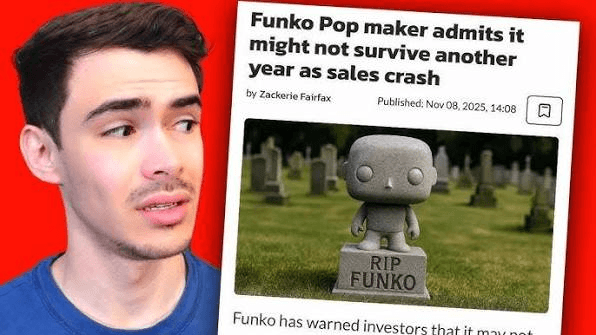


Funko has not shut down. It has not filed for bankruptcy. But its own SEC filings include formal language stating there is “substantial doubt” about whether the company can keep operating for the next 12 months without major financial changes.
That is not a rumor from social media. That is a legal disclosure from Funko’s own management and auditors.
This article breaks down what that warning actually means, what the numbers show, how Funko got here, and what realistically could happen next — whether you’re a collector, an investor, or just someone who noticed the headlines.
Funko Is Still Open — But Its Own Filings Raise a Real Red Flag
If you’ve seen posts on Facebook or YouTube claiming “Funko is shutting down,” those are not based on any official announcement. Funko has not announced a closure or filed for any form of bankruptcy as of its most recent filings.

But the concern is real — and it comes directly from Funko itself.
In its SEC quarterly filings (10-Q), Funko disclosed a formal “going concern” warning. This is a specific accounting and legal term. It’s not spin or speculation. It means the company’s management and its auditors have concluded that, without significant changes, the business may not be able to survive the next 12 months in its current form.
Funko representatives have publicly stated the company expects to be in business “for many years.” At the same time, their own legal filings say the opposite is a real risk. Both things can be true — the company is still operating and actively trying to fix its problems, while also facing a genuine financial threat.
What a “Going Concern” Warning Actually Means
Most people have never heard the term “going concern” unless they work in accounting or finance. Here’s what it means in plain terms.
When auditors or management issue a going concern warning, they’re saying the company may not be able to pay its bills or meet its financial obligations over the next year without a major change — like new financing, selling the company, or cutting operations significantly.
It does not mean the business closes tomorrow. Think of it like a household with a large loan balance, shrinking income, and a big payment deadline coming up. The family isn’t bankrupt yet, but the bank is watching closely. Unless they refinance, sell something, or bring in more money, they’re in serious trouble.

The key detail with Funko is this: the warning was reiterated — meaning it wasn’t a one-time flag. It appeared again in subsequent filings, which signals the situation hasn’t improved enough to remove it.
Funko’s filings specifically note that the company may not have enough cash to repay loans maturing in September 2026 without refinancing or another major transaction. That deadline is the clock everyone is watching.
Companies do recover from going concern warnings. It requires refinancing debt, cutting costs, or finding a buyer. It’s serious — but it’s not automatically a death sentence.
The Numbers Behind Funko’s Financial Trouble
The going concern warning is alarming enough on its own. But the numbers in Funko’s SEC filings make the picture clearer.
- Debt: Funko carries approximately $241–250 million in total debt.
- Sales decline: Global sales fell roughly 14% year-over-year in Q3. Domestic U.S. sales dropped about 20%.
- Profit swing: Funko reported a net loss of roughly $1 million in Q3, compared to a profit of over $8 million in the same quarter the year before.
- Current liabilities: These jumped approximately 50% year-over-year to around $457 million.
- Stock price: By some accounts, Funko’s stock dropped roughly 75–80% year-to-date.
These are not projections or analyst guesses. They come from Funko’s own SEC filings, reported across multiple outlets including Kotaku, ComicsBeat, Retail Dive, and TheStreet.
The combination of rising debt, falling sales, and a shift from profit to loss in a single year tells you the financial pressure is real and building quickly.
How Funko Got Here
Funko didn’t collapse overnight. Several factors stacked up over time, and no single one is entirely to blame.
Overproduction and collector fatigue
Funko once had a simple formula: license popular characters, make affordable vinyl figures, sell them everywhere. It worked extremely well — for a while. But the company produced so many figures across so many properties that the market became saturated.
Collectors who once hunted for specific Pops started feeling overwhelmed. Retail shelves at Walmart, Target, and comic shops were packed with Funko products. Over time, that shelf space started shrinking as retailer orders declined.
Tariffs and retailer caution
Tariffs added cost pressure and made retailers more cautious about holding large Funko inventory. A comic shop owner who might have ordered 50 figures now orders 20, because sitting on unsold stock is risky when margins are tight. When many retailers make that same calculation at once, Funko’s sales drop sharply.
The feedback loop
Slower sales lead to less confidence from creditors. Less confidence leads to tighter credit terms. Tighter credit makes it harder to fund new product lines or marketing. Fewer new products lead to even slower sales. That loop is what makes the current situation difficult to escape without outside help — either new financing or a strategic deal.
What Funko Is Doing About It
Funko isn’t sitting still. The company has engaged Moelis & Company, a financial advisory firm, to help refinance its credit agreement. That’s a standard move for a company trying to negotiate better loan terms before a deadline hits.
Management has also pointed to a few positive signs: improved profit margins in some areas, the performance of newer product lines like Bitty Pop, and recently renewed multi-year licensing agreements with partners. Those licensing deals matter — they show that brands still see value in working with Funko.
The company is also exploring what it calls “strategic alternatives.” In corporate language, that usually means the company is open to being acquired, merging with another business, or significantly downsizing operations.
For a deeper breakdown of how companies navigate financial distress like this, Business Regards covers business strategy and corporate finance in practical terms worth reading.
What Could Actually Happen Next
There are a few realistic scenarios here, and none of them are certain.
Refinancing and turnaround
If Funko successfully refinances its debt before the September 2026 deadline, it buys time to stabilize. That would likely involve cutting costs, reducing its product catalog, and focusing on its strongest-selling lines. Possible — but it requires lenders to agree to new terms while the business is still declining.
Acquisition
This is the scenario many analysts consider more likely than a full collapse. Funko holds a large portfolio of licensed pop culture collectibles across movies, TV, games, and music. That licensing library has real value. A larger toy company or entertainment company could buy Funko, keep the brand running, and restructure the debt under stronger financial footing. Collectors would likely see continuity in the product line under new ownership.
Chapter 11 bankruptcy
If Funko breaches its debt covenants and can’t refinance, its own 10-Q filing acknowledges that Chapter 11 bankruptcy (reorganization) is a possible outcome. Under Chapter 11, the company keeps operating while restructuring its debts and obligations. Some product lines or facilities might close, but the business wouldn’t necessarily disappear.
Chapter 7 liquidation
This is the most severe outcome — a full shutdown where assets, licenses, and inventory are sold off. Another company could potentially buy the rights and continue making similar products, but Funko as it exists today would be gone. This outcome is possible but appears least likely given the brand’s licensing value.
What This Means for Collectors
If you collect Funko Pops, you’re probably wondering whether your collection will go up in value if the company struggles. The honest answer is: it depends, and there’s no guarantee.
In some collectibles markets, when a manufacturer cuts production or shuts down, existing items become scarcer and more valuable. But scarcity alone doesn’t drive prices up — demand has to stay strong too. If overall interest in Funko Pops declines alongside the company’s troubles, prices may not rise the way you’d hope.
The practical advice: don’t buy Funko products purely as a financial investment right now. If you enjoy collecting them, that’s a fine reason to continue. But basing purchasing decisions on speculation about collapse-driven value increases is a risky bet.
The Bottom Line
Funko is not out of business, and no official closure or bankruptcy filing has happened. But the company’s own disclosures make clear that it is in serious financial trouble — with roughly $250 million in debt, falling sales, a shift from profit to loss, and a formal going concern warning that has appeared more than once in its filings.
The most likely outcomes are a refinancing deal, an acquisition, or some form of restructuring — not necessarily a complete shutdown. But the September 2026 debt deadline is a hard marker, and if Funko can’t find a path to refinancing or a buyer before then, the situation gets significantly worse.
Also Read This :