


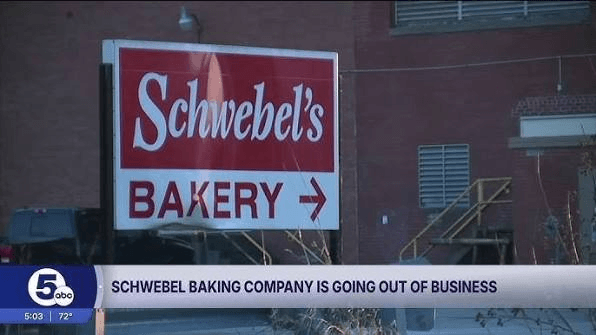


After 120 years of baking bread in Youngstown, Ohio, Schwebel Baking Company has announced it is closing for good. This isn’t a restructuring, a temporary shutdown, or a sale to a new owner. The company is fully liquidating — and that means everything stops.
If you’re a loyal customer, a local employee, or just someone who grew up seeing Schwebel’s loaves on the grocery shelf, here’s a clear breakdown of what’s happening, when, and why.
Yes, Schwebel’s Is Going Out of Business
There’s no soft way to put it: Schwebel’s is done. The board of directors voted to wind down all operations and pursue a formal liquidation of the business. That language came directly from the company’s press release in mid-June 2026, and it was confirmed by local Ohio media including News 5 Cleveland, the Akron Beacon Journal, and the Tribune Chronicle.
This is not a partial closure. No locations are being kept open. No other company is taking over the brand — at least not as of what’s been publicly confirmed. The company says it evaluated all available alternatives before making this call, including an active but unsuccessful search for a buyer.

When a company says “formal liquidation,” it means assets get sold off and the business ceases to exist in any operational form. That’s where Schwebel’s is headed.
The Timeline — When Schwebel’s Will Actually Close
Schwebel’s planned to continue normal operations through the July 4, 2026 weekend. After that, production and distribution were set to halt gradually over the following weeks and into late summer 2026.
No single “last day” was announced initially. The company described it as a wind-down happening over several weeks. So rather than one hard cutoff, the process is more like a slow stop — products disappear from shelves as inventory runs out and distribution ends.
Some customers responded to the news by planning a final visit to Schwebel’s outlet stores or stocking up before the July 4 deadline. That reaction says a lot about how connected the brand was to the people who grew up with it.
If you’re hoping to grab one last loaf, don’t wait too long. Once production stops, store shelves won’t be restocked.
Which Locations Are Affected
The entire operation is shutting down. That includes:

- The Youngstown bakery on East Midlothian Boulevard — the company’s corporate headquarters and main plant
- The Hebron, Ohio bakery
- Retail outlet stores and distribution centers across Ohio, Pennsylvania, and New York
- Bakery Outlet Thrift Stores in Erie, McKeesport, and Franklin, Pennsylvania
Nothing is being spun off or kept running under a different name. Whether you’re a shopper at one of the outlet thrift stores in Pennsylvania or a grocery customer in Northeast Ohio, the result is the same — Schwebel’s products will stop being available once the wind-down is complete.
Why Schwebel’s Could Not Keep Going
This didn’t happen overnight, and it wasn’t just one problem. The company cited a combination of factors that, together, made a path forward impossible.
Aging Facilities and Equipment
The bakery’s manufacturing plants were old and expensive to maintain. Think of it like an aging machine that keeps breaking down — at some point, the cost to repair it each year exceeds what it produces in value. Modernizing the facilities would have required significant capital investment that the company couldn’t justify given falling revenue.
Labor Contracts and Pension Obligations
Schwebel’s carried fixed labor costs that didn’t shrink even as sales declined. Pension obligations work like a fixed monthly bill — it doesn’t matter how much product you sell that month, the obligation stays the same. When revenue drops but these costs don’t, the financial pressure builds fast.
Declining Demand for Traditional Bread
Consumer habits have shifted significantly. More shoppers are choosing artisan bread, low-carb alternatives, or simply buying less packaged bread than they used to. Schwebel’s was built around mass-market sliced sandwich bread — the kind of product that filled grocery store shelves for decades. That category has been shrinking, and Schwebel’s felt it directly.
This isn’t unique to Schwebel’s. Smaller regional commercial bakeries across the country have struggled as national brands compete on price and health-focused products pull shoppers in another direction. But for a company already dealing with aging equipment and fixed pension costs, the demand drop was the final blow.
No Buyer Could Be Found
The company didn’t jump straight to liquidation. According to reporting, Schwebel’s actively searched for a buyer before deciding to shut down. That search came up empty. Without a buyer willing to take on the facilities, the workforce, and the debt, liquidation became the only realistic option left.
What This Means for Employees and the Youngstown Area
The closure will result in job losses across bakeries, distribution centers, and outlet stores in multiple states. The exact number of employees affected and the details of any severance packages have not been publicly disclosed, so it would be wrong to put a specific figure here.
What is clear is that the impact hits hardest in Youngstown and the Mahoning Valley, where Schwebel’s has operated for over a century. The company’s slogan — “Youngstown Born, Youngstown Bread” — wasn’t just marketing. It reflected a real, long-standing connection between the bakery and the region.
Youngstown has already seen decades of manufacturing decline. Schwebel’s closing is another reminder of how difficult it has become for legacy regional manufacturers to survive against the combination of rising fixed costs, changing consumer demand, and competition from larger, better-capitalized players.
For workers losing their jobs, the challenge now is finding comparable employment in a region that has fewer large manufacturing employers than it once did. For the community, it’s losing another piece of local identity that can’t easily be replaced.
If you want to read more about how regional businesses navigate closures and economic shifts, Business Regards covers these topics with the same practical focus.
What Happens to the Brand and What Customers Can Do
As of the announcements made in June 2026, there is no confirmed plan for the Schwebel’s brand to continue under new ownership. Liquidation means assets are sold off — that could include equipment, real estate, and potentially the brand name — but nothing has been announced publicly regarding a brand sale or continuation.
For loyal customers, the practical reality is simple: once Schwebel’s stops producing and distributing, grocery stores will fill that shelf space with other brands. National brands and store-brand bread will likely take over in most retail locations. Some regional bakeries may pick up market share, but there won’t be a direct replacement for what Schwebel’s specifically offered to its longtime customers.
If you want to find a similar product, look for other regional sandwich bread brands in your area or compare ingredients on grocery store alternatives. The style of bread Schwebel’s was known for — soft, sliced, and straightforward — is still widely available, just not under that label.
The Bigger Picture
Schwebel’s story is a useful example of the pressures facing mid-sized regional food manufacturers right now. They often can’t modernize as quickly as large national companies. They carry legacy costs — pensions, older facilities, long-standing labor agreements — that newer competitors don’t face. And they’re selling into a market where consumer preferences are moving away from the core products that built the business.
That’s not a unique situation. Similar stories have played out in regional dairy, meatpacking, and now commercial baking. The companies that survive tend to either modernize aggressively with significant capital investment, shift their product line toward what consumers actually want, or get acquired by a larger company that can absorb the costs. Schwebel’s ran out of those options.
After 120 years, the company tried to find a way forward and couldn’t. That’s a straightforward, if difficult, business reality — and it explains why even a well-known regional brand with genuine community loyalty still ends up closing its doors.
Also Read This :