



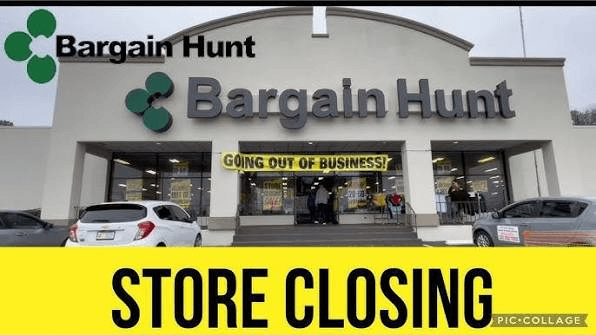


If you’ve been hearing that Bargain Hunt is closing and you’re wondering whether it’s temporary — it’s not. Every single Bargain Hunt store is shutting down permanently. This isn’t a partial pullback or a restructuring play. The chain is done.
Here’s a clear breakdown of what happened, when it happened, and what it means for shoppers, employees, and the broader discount retail space.
Bargain Hunt Is Permanently Closing All of Its Stores
The parent company behind Bargain Hunt, Essex Technology Group LLC, filed for Chapter 11 bankruptcy on February 3, 2025, in the U.S. Bankruptcy Court for the Middle District of Tennessee.
What makes this different from a typical Chapter 11 filing is that there’s no restructuring plan. No stores are being saved. All 92 locations across 10 states are closing for good through a full liquidation process.

As of March 2025, multiple sources including Retail Dive, USA Today, Newsweek, and Wikipedia describe the chain as defunct. There are no reports of a planned online continuation, a new owner keeping the brand alive, or any kind of relaunch. Bargain Hunt is finished as a retail operation.
A Quick Background on What Bargain Hunt Was
Bargain Hunt was founded in 2004 and headquartered in the La Vergne/Antioch area near Nashville, Tennessee. At its peak, it ran 92 stores across 10 states: Tennessee, Ohio, Indiana, Kentucky, Georgia, North Carolina, South Carolina, Alabama, Mississippi, and Arkansas.

The stores sold discounted merchandise — things like clothing, home goods, toys, electronics, pet supplies, and sporting goods. Inventory shifted regularly based on what the company could buy from overstock and surplus channels.
That “treasure hunt” model was part of the appeal. Shoppers never quite knew what they’d find, which gave the stores a different feel from a standard discount chain. For budget-conscious shoppers in the South and Midwest, it filled a specific niche.
Key Dates and What Customers Need to Know
If you still have a Bargain Hunt gift card or were thinking about heading to a store, here’s the practical side of the situation.
Liquidation sales started in early February 2025. Most stores were expected to close by the end of February 2025, with some liquidation activity noted into early March. The discounts advertised were up to 40% off the lowest ticketed prices on in-store merchandise.
Two important customer cutoffs to know:
- Gift cards: Bargain Hunt stopped accepting gift cards around February 12, 2025. After that date, they were no longer honored.
- Returns: The same cutoff applied. Returns were not accepted after approximately February 12.
All sales were in-store only. There was no online component. The liquidation was managed by two firms — Hilco Consumer – Retail and Gordon Brothers — who also handled the sale of store fixtures and equipment.
One practical note if you were shopping the liquidation: discount chains typically start with modest markdowns and cut deeper as the closing date gets closer. The best deals usually came in the final days before each location shut its doors.
Why Bargain Hunt Filed for Bankruptcy
There’s no single reason this happened. Essex Technology Group pointed to competition from across the retail spectrum — big-box stores, convenience chains, and online platforms all eating into the customer base that Bargain Hunt depended on.
At the same time, inflation and supply chain disruptions hit the closeout model hard. Bargain Hunt’s entire business depended on buying surplus and overstock merchandise cheaply and reselling it at low prices. When supply chains tighten and costs rise, those margins — already thin — can collapse fast.
The company also carried significant debt. Court filings show reported assets in the range of $10–50 million against liabilities in the range of $50–100 million. Those are ranges, not exact figures, but they point to a company operating with more obligations than resources. Trade reporting from Home Textiles Today noted that the company owed multi-million dollar sums to suppliers, with Amazon specifically mentioned among its creditors.
The core tension is worth understanding: closeout retail works well when there’s a steady flow of surplus inventory available at rock-bottom prices. When that supply dries up or gets more expensive, the whole model gets squeezed. Bargain Hunt couldn’t outlast those pressures.
How This Closure Affects Employees, Landlords, and Communities
The human impact here is real. Nearly 300 employees at the Antioch, Tennessee distribution center alone were affected, on top of store-level staff across all 92 locations. That’s a significant number of jobs lost in a short window.
For landlords, Bargain Hunt’s store leases are being marketed and auctioned off as part of the bankruptcy process. Shopping center owners who had Bargain Hunt as a tenant are now looking for replacement tenants for those midsize retail spaces. That’s not always easy in the current environment, especially in smaller markets.
For the communities where these stores operated, the closure removes a low-price shopping option that many budget-conscious households relied on. Bargain Hunt served a lot of suburban and lower-income areas where affordable goods matter. Losing that option isn’t trivial.
What This Says About Discount Retail Right Now
Bargain Hunt isn’t an isolated case. 2025 has seen a notable wave of retail bankruptcies and store closures, including among specialty and mid-tier chains. The discount and off-price segment, which many assumed would be recession-proof, has been hit harder than expected.
Part of what’s happening is that the competition for the budget shopper has changed dramatically. Amazon Warehouse Deals, online liquidation platforms, and big-box clearance sections have moved into territory that used to belong to physical closeout stores. Those online channels have lower overhead and wider reach. A brick-and-mortar closeout chain simply can’t match that on price or convenience.
For business readers, Bargain Hunt is a useful case study. It wasn’t a poorly run operation on its face — it had nearly 100 stores and operated for over 20 years. But the combination of heavy debt, rising costs, supply chain volatility, and intensifying competition made the model unsustainable. When margins are already thin and multiple pressures hit at once, there’s very little buffer.
If you follow retail trends, resources like Business Regards cover the business side of these shifts in plain terms — useful if you want to track how broader market forces are reshaping retail beyond just one chain’s closure.
Common Questions, Answered Directly
Is every Bargain Hunt store closing, or just some?
Every store. All 92 locations across all 10 states are permanently closing. This is not a selective pullback.
Will Bargain Hunt reopen online or under a different name?
No credible source suggests that’s happening. Current reporting from every major outlet treats this as a complete exit from retail.
What happened to employees?
Hundreds of workers lost their jobs, including nearly 300 at the Tennessee distribution center alone, plus store staff chain-wide.
Were the liquidation discounts worth shopping?
Discounts up to 40% off were advertised, which is meaningful. But early liquidation stages often start with more modest markdowns. The deeper cuts tend to come closer to the final closing date of each store.
The Bottom Line
Bargain Hunt is not going through a rough patch. It is not restructuring. The chain has permanently closed all 92 stores following a Chapter 11 bankruptcy filing in early February 2025, and the company is listed as defunct as of March 2025.
The reasons are layered — competition, debt, supply chain pressure, and thin margins all played a role. The closure follows a broader pattern of discount and closeout retailers struggling to survive in a market where online platforms have taken over much of the bargain-hunting experience.
If you were a regular customer, the stores are gone. If you’re a business reader watching the retail sector, this is one more data point showing how quickly a two-decade-old chain can unravel when the economics stop working.
Also Read This :